Lottery Draw Machines
Race-Track Theme 10-Ball Lottery Machine
- Ten 40mm balls race a visible oval track under LED lighting before every draw
- RFID auto-identification reads and orders up to 10 winning balls, one by one
- No physical switches on the machine — operated only from a remote console
- Runs from SQL Server, a website, a workstation or your own client software
- Air-mix action on the track keeps every draw visibly random for spectators
- 3000W drive, 113kg cabinet, 1760mm tall — a standalone draw centerpiece
- Draw sequence configurable to your game rules before the machine ships
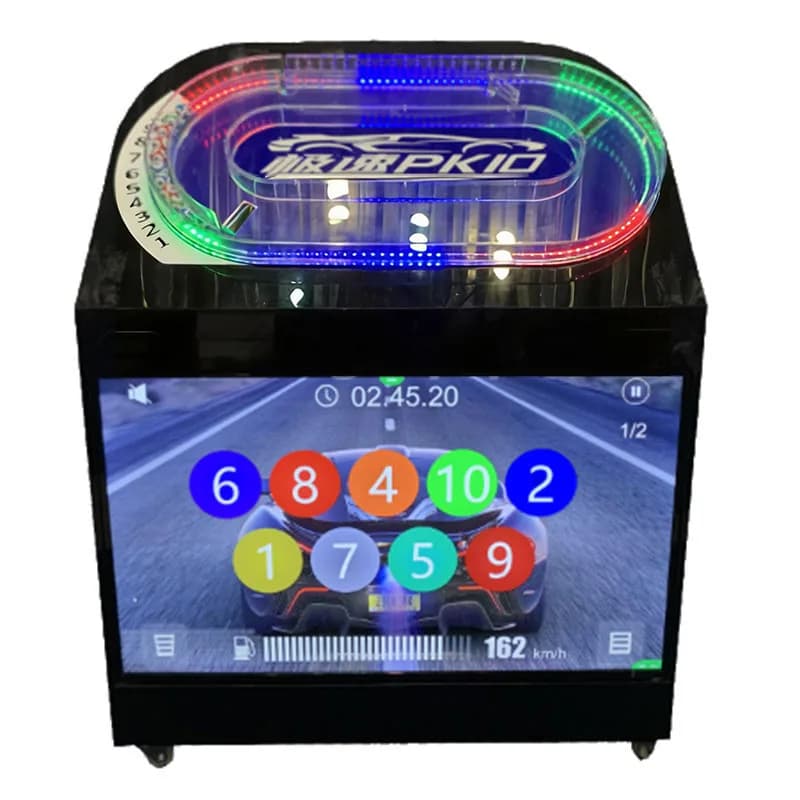
No On-Machine Switches
How the 10-Ball Race-Track Draw Runs From Gate Open to RFID Read-Out
The Race-Track Theme 10-Ball Lottery Machine is a floor-standing draw machine built for racing-game and virtual-sports operators who run software-driven number draws. Ten 40mm balls speed around a visible oval track, then an RFID system identifies and orders up to 10 winning balls one at a time. The machine itself carries no physical switches at all — every draw is started and controlled from a remote console through SQL Server, a website, a workstation, or your own client software, which makes it a natural fit for venues that already manage their games from a central system.
What actually happens during a draw on this racing theme lottery machine?
A complete draw runs as a staged race. Ten balls start at the top of the track. When the gate opens and the blower switches on, the balls are released onto the racetrack and begin racing around the circuit. While they run, gates arbitrarily disrupt their movement so the balls mix properly instead of following a fixed order. After a preset time — which you control from the console — the door at the top of the chamber opens and the balls come to rest at the same position where they started. They are then released one at a time, identified automatically by the RFID system, and displayed vertically in their numbered positions. The whole sequence is visible to the audience: preview, air mixing, racing, and the final ordered display of up to 10 winning balls. That visibility is the point of the machine — a draw that spectators can watch like a race, not a result that appears from a closed box.
Why are there no physical switches on the machine?
Because this model is designed to be driven entirely by software. The racetrack unit has no buttons, key switches, or control panel on its body. Instead, every machine ships with a remote console, and the operator runs the draw through SQL Server, a website, a solution workstation, or software the customer has developed in-house. For buyers, this changes how the machine fits into a venue. Draw timing, the preset mixing period, and the release sequence can all sit inside your existing game-management system rather than being handled by a staff member standing at the cabinet. It also means the machine on the floor cannot be started, stopped, or interfered with locally — useful in public spaces where the unit runs unattended between draws. If your operation already logs draws to a database or publishes results to a web front end, this control architecture is the reason to shortlist this model over mechanically switched machines.
How are the winning numbers read and ordered?
Recognition is handled by RFID, not by cameras, sensors on the track, or manual entry. After the racing and mixing phase ends, balls are released one at a time past the RFID reader, which identifies each ball's number automatically. The machine then places them vertically in their numbered positions, so the result is an ordered sequence of up to 10 balls — not just a set of winners, but a ranked order, which is what race-style and position-based games need. Because identification is automatic, the draw order recorded by your console software and the order displayed on the machine are the same data, with no transcription step in between. For operators running draws on a schedule or publishing results through their own site, this removes the weakest link in most draw workflows: a person reading numbers off the machine and typing them into a system.
Who is this racetrack draw machine built for?
The buyers who get the most from this model are racing-game and virtual-sports operators whose draws are already part of a larger software stack. Typical situations: a venue runs scheduled race-themed number draws and wants the machine on the floor to double as a spectator attraction; an operator manages several units from one back-office system and cannot staff each machine; or a game developer needs hardware that their own client software can drive directly. The 1760mm-tall, 113kg cabinet is built as a standalone centerpiece — the illuminated track with fast-moving balls is deliberately eye-catching, so the machine earns floor space as an attraction between draws, not only during them. If your draw is a private back-office process with no audience, a simpler chamber machine will do the job at lower cost; this model justifies itself when the draw itself is part of the show.
How does it compare with chamber-style and air-blower draw machines?
The trade-off is spectacle and software integration against footprint and power. Chamber-style machines mix balls inside an enclosed drum or jet chamber; they are compact and simple, but the audience watches balls tumble in a box, and control is usually local. This racetrack model replaces the chamber with a visible oval circuit where 40mm balls race at speed — a stronger visual, but it needs a 1340 × 650mm floor footprint and a 3000W supply. The other difference is operational: chamber machines are typically started at the machine, while this unit has no local controls at all and only responds to the remote console. Buyers who need a self-contained, staff-operated machine for occasional event raffles are usually better served by a chamber model. Buyers running repeated, scheduled, system-logged draws in front of an audience are the ones this machine is built for.
Installation, power and day-to-day upkeep
The machine is supplied for either 110–120V 60Hz or 220–240V 50Hz mains, so it can be matched to your destination market before shipping — confirm your local standard when requesting a quote so the correct configuration is built. The cabinet stands 1760mm high on a 1340 × 650mm base and weighs 113kg, so plan door widths and floor loading for a full-size cabinet rather than a tabletop unit. Upkeep is simple: do not let sharp tools contact the machine body, as they will scratch the facing, and clean with a damp soft cloth only — no special detergent is needed. Jisun backs the machine with 36 months of after-sales service, free technical support from a professional team, and CE certification across the range, so your technician has factory support for the control integration as well as the hardware itself.
RFID Racetrack Draw
Race-Track 10-Ball Machine Specifications
- Net Weight
- 113 kg
- Rated Power
- 3000 W
- Control Mode
- Remote console only (SQL Server, website, workstation or client software); no physical switches on machine
- Power Supply
- 110–120 V 60 Hz or 220–240 V 50 Hz
- Ball Diameter
- 40 mm
- Certification
- CE
- Mixing Method
- Air mixing on a visible race track
- Working Balls
- 10 balls
- Number Recognition
- RFID automatic identification
- Overall Dimensions (L × W × H)
- 1340 × 650 × 1760 mm
Where a Racing Theme Lottery Machine Earns Its Floor Space
Custom Game Logic and Software Integration for This Racetrack Draw
- Machine logic and draw sequence configured to your game rules — describe your game and we set the machine accordingly
- Control integration with customer-developed software via the remote console
- Choice of control path: SQL Server, website, or solution workstation
- Ordered draw of up to 10 balls, matched to your race-style game format
- Machine dimensions adapted to fit your venue
- Free pre-sale consultation and machine design service for custom builds
Buyer Questions
Race-Track 10-Ball Lottery Machine FAQ
How many balls can the machine draw and order in one game?
The machine works with 10 balls and can identify and order up to 10 winning balls per draw. After the racing and air-mixing phase, balls are released one at a time, read automatically by the RFID system, and displayed vertically in their numbered positions — so you get a ranked sequence, not just an unordered set of winners. The draw timing is a preset period that you control from the remote console.
Can the machine be operated without your software — for example, from our own system?
Yes. The machine has no physical switches at all and is operated only through a remote console. The console can run via SQL Server, a website, a solution workstation, or software developed by the customer. If your in-house system already manages draws and logs results, it can drive the machine directly — tell us your integration setup when you enquire and we will confirm the connection details.
What are the size, weight and power needs of the race-track 10-ball machine?
The cabinet measures 1340 × 650 × 1760mm (L × W × H) and weighs 113kg, so it installs as a full-size floor unit. Rated power is 3000W. Two electrical configurations are available: 110–120V 60Hz or 220–240V 50Hz. State your local supply standard when requesting a quote and the machine will be built to match. The machine is CE certified.
What size balls does the racetrack use, and how is randomness ensured?
The machine is designed for 40mm diameter drawing balls. Randomness comes from the track itself: when the gate opens and the blower starts, the balls race around the circuit while gates arbitrarily disrupt their movement for proper mixing. The mixing period is a preset time that you control, after which the top door opens and the balls return to their start position for the ordered RFID read-out.
Can the machine be customized to our game rules?
Yes. We configure the machine according to your game — describe your game format to us and we set up the machine to your requirements before shipping. Dimensions can also be adapted to fit your venue. Customization is handled as a pre-sale engineering discussion, so the machine arrives already matched to your draw format rather than needing adjustment on site.
Crating, Power Configuration and 36-Month After-Sales Cover
The figures below follow common B2B export practice for arcade and amusement equipment. Final MOQ, schedule, freight term, and warranty coverage are confirmed in the quotation or proforma invoice for your order.
- MOQ
- 1 unit (sample order accepted)
- Confirmed for this product.
- Production Lead Time
- 15 days
- Estimated production time after order confirmation.
- Shipping
- EXW / FOB / CFR / CIF
- Available trade term for this product.
- Warranty
- 36 months
- Product warranty period confirmed for this model.
Amusement-only, no cash payout. Local compliance required; operator is responsible for local regulations.