Category: Boxing Machines
PulseForge Duo Arena
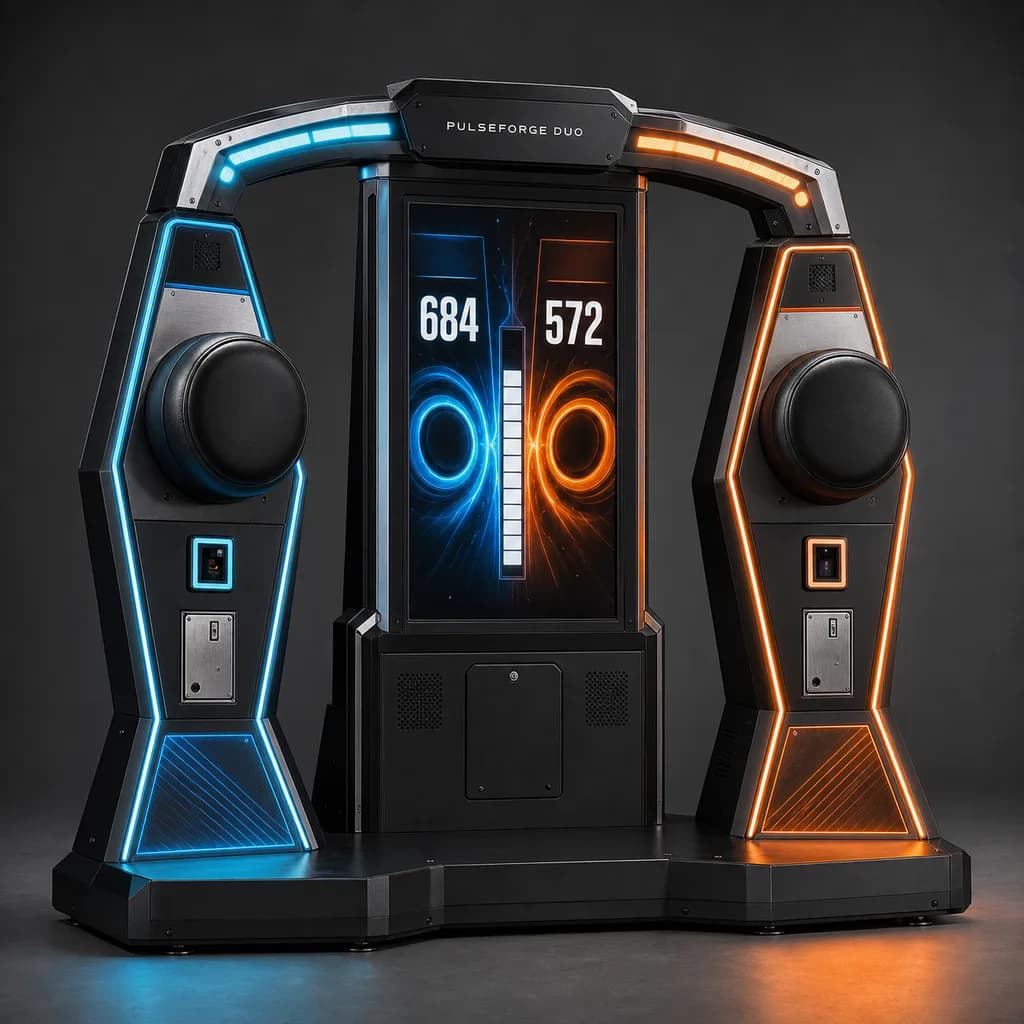
Concept design — fully customizable. Contact us to make it real.
This concept and its visualization were developed with AI assistance, then reviewed before publication. Final engineering, dimensions, materials, compliance and commercial terms require project confirmation.
- ✓Two-player boxing competition in one shared cabinet
- ✓Measures timing and accuracy as well as striking force
- ✓Versus, cooperative, and solo gameplay concepts
- ✓Configurable redemption and payment integrations
- ✓Service-friendly replaceable target modules
- ✓OEM graphics, software, lighting, and language options
PulseForge Duo Arena
Concept design — fully customizable. Contact us to make it real.
A social boxing attraction built for modern arcades
PulseForge Duo Arena reimagines the traditional arcade boxing machine as a two-player, light-guided competition and cooperative redemption experience. Rather than relying on a single hanging bag and one maximum-strength score, the concept uses two fixed striking stations connected by a central illuminated tower. Its distinctive silhouette combines a faceted charcoal base, two angled player wings, a curved overhead light bridge, and a vertically mounted display that remains visible to players and spectators. Electric cyan and vivid orange lighting separates the two sides, while edge-lit translucent panels create a premium focal point without requiring an oversized cabinet.
Mechanism and gameplay
Each player strikes a replaceable padded target containing a proposed combination of force, timing, and motion sensors. The system can evaluate power, response speed, rhythm, and hit accuracy instead of rewarding force alone. In Versus mode, players race through illuminated strike prompts and build multipliers with accurate timing. In Reactor mode, both players cooperate to stabilize a shared energy meter, encouraging families and mixed-skill groups to play together. A Solo Training mode can provide short reaction drills during quieter periods. Configurable scoring rules would let operators emphasize casual competition, repeat play, or redemption performance.
The central screen can display animated round introductions, live scores, combo feedback, venue branding, and a spectator-friendly final result. Proposed integrations include coins, tokens, bills, cards, QR-based venue systems, amusement-only scoring, or ticket redemption. Payout logic, regional payment hardware, and software language packs would be defined during customization.
Designed around operator concerns
The concept is intended for family entertainment centers, mall arcades, bowling venues, cinema game zones, and branded competitive-social spaces. The two stations share one central cabinet, creating a multiplayer attraction with a more efficient footprint than two separate boxing units. Adjustable audio levels and attract-mode lighting schedules can help suit both energetic game centers and noise-sensitive mall locations.
High-contact components are conceived as front-access, replaceable modules. Target pads, protective covers, sensors, and payment hardware could be serviced without dismantling the complete cabinet. Rounded player-facing edges, stable floor mounting points, guarded internal mechanisms, and configurable impact limits would be addressed during engineering. Final electrical standards, accessibility details, safety testing, and certification documentation must be scoped for the destination market.
Customization for distributors and venue groups
PulseForge Duo Arena can be developed with alternative cabinet colors, printed graphics, molded decorative parts, display sizes, lighting programs, scoring formats, payment systems, prize logic, and multilingual interfaces. A distributor edition might use durable neutral branding, while an FEC chain could specify themed character graphics, custom sound design, and synchronized leaderboard content. The cabinet structure can also be evaluated for modular packing and international freight efficiency.
This is a ground-up OEM concept rather than a cosmetic variation of a conventional strength tester. Cabinet dimensions, technical configuration, commercial terms, estimated production schedule, and packaging plan would be confirmed after requirements review and prototype validation.
Customize · Get a Quote
Customization Questions
- Which parts of the concept can be customized?
- The cabinet dimensions, color palette, graphics, lighting behavior, gameplay rules, screen content, language, payment interface, and redemption logic can all be reviewed. Engineering feasibility and destination-market requirements are confirmed before the final specification.
- What are the MOQ and wholesale price?
- MOQ and quotation depend on the level of customization, tooling needs, electronics, certification scope, and projected volume. Share the destination market, preferred quantity, payment system, and branding requirements so Jisun can prepare a project-specific quote without inventing a one-size-fits-all price.
- What affects the development schedule for the PulseForge Duo Arena?
- As a new concept, the schedule would include specification approval, industrial engineering, prototype development, testing, buyer review, and production planning. A realistic timeline can be provided after the customization scope and any certification requirements are understood.
- What venues would fit PulseForge Duo Arena?
- The concept is aimed at medium-to-large FECs, mall arcades, bowling centers, cinema game areas, and social gaming venues. Final placement should allow comfortable player movement, spectator visibility, suitable floor anchoring, and clearance around both striking stations.