How to Start a Gacha Machine Business
A practical manufacturer’s guide to starting a gacha machine business, from location testing and capsule planning to equipment sourcing, installation, and launch economics.
AI assisted with the initial draft and structure. The published page is reviewed against Jisun source facts, product context and editorial requirements; the named reviewer is shown above when assigned.
To start a gacha machine business, choose a specific venue and audience, estimate plays and prize cost, select a cabinet that fits the site, confirm power and payment requirements, and order from a commercial supplier. Start with a measurable pilot, track every play, then expand only after the location proves profitable.
What does a gacha machine business actually sell?
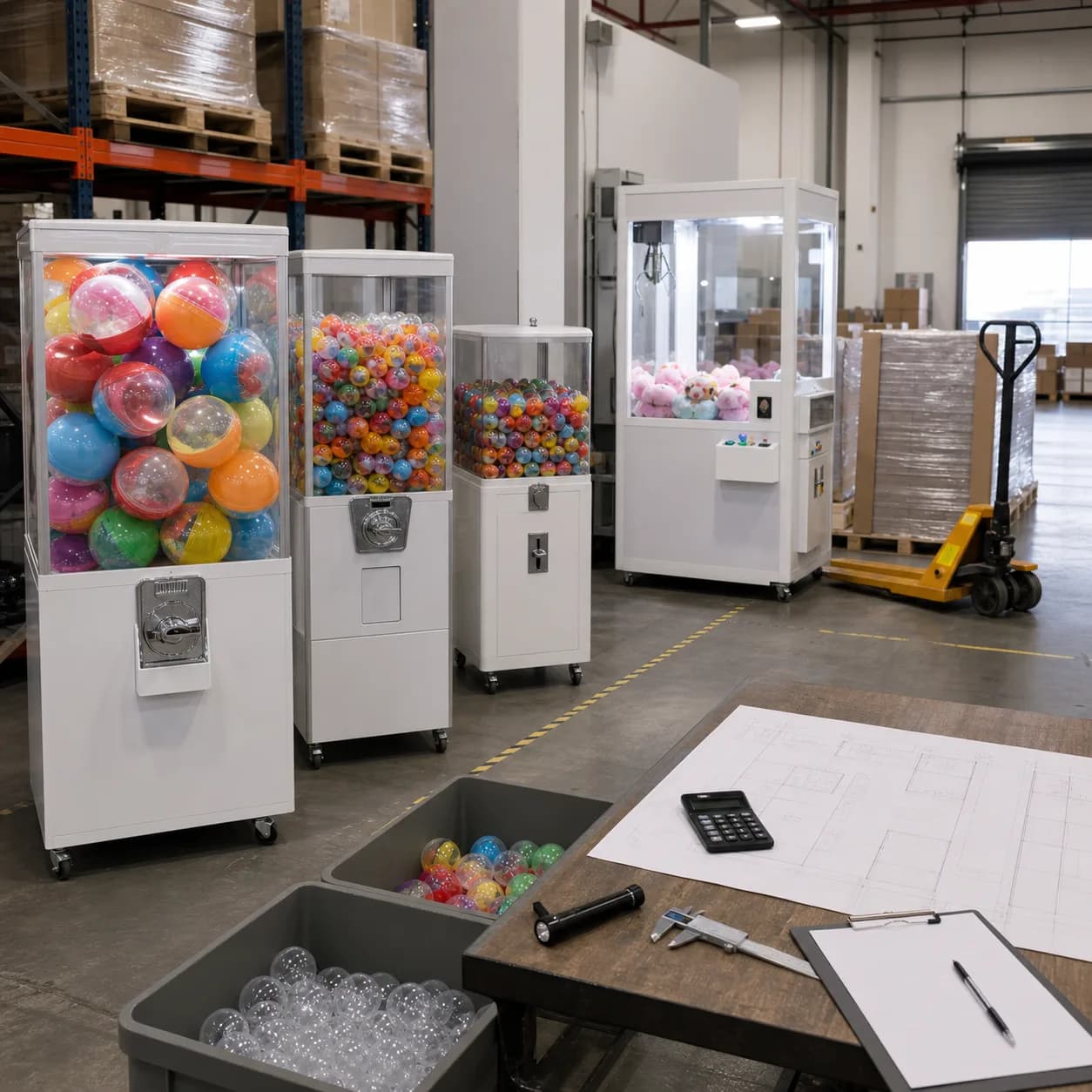
A gacha machine business sells a short, repeatable moment of anticipation rather than the capsule alone. A gacha machine is a coin-, token-, or electronically activated vending game that dispenses a randomized capsule prize after payment. Operators earn revenue from each play and control margin through the relationship between play price, merchandise cost, restocking, venue charges, and machine expenses. Some businesses place one cabinet in a retail store; others build a mixed attraction zone with capsule vending and skill-based prize games. From our factory perspective, the winning concept starts with a defined customer: children shopping with parents, collectors seeking a series, or arcade visitors already comfortable buying game credits.
Gacha and prize games are related, but they don’t create the same experience. Capsule vending provides a guaranteed item, while a skill-based prize game makes winning dependent on play. New operators can compare both categories through our Gacha & Prize Game Machine Supplier page before deciding whether to build a capsule-only route or a broader prize-game mix.
How should you validate a location before buying machines?
Validate a location by observing qualified foot traffic, dwell time, customer age groups, competing attractions, visibility, and the path staff will use for refilling. Raw visitor counts can mislead. A busy corridor where nobody stops may underperform a smaller waiting area with families and repeat customers. We ask buyers to mark the proposed cabinet position on a floor plan, confirm the usable footprint, and identify nearby power access before choosing a model. The machine should face approaching guests without blocking circulation, emergency routes, store displays, or service access. Run the pilot in one clearly measured position and record daily plays, refill frequency, downtime, and prize demand.
Match the venue before selecting artwork. Our compact upright format has a 45x74x180cm footprint intended for malls, FECs, retail stores, and supermarkets. That makes it easier to evaluate against an actual leasing drawing instead of guessing from product photos. Leave practical working room around the cabinet for doors, cleaning, capsule loading, and technician access; the machine’s listed footprint isn’t the entire operating zone.
Which type of machine should a new operator choose?
Choose the first machine by business model, not appearance. A compact upright gacha cabinet suits capsule-led retail concepts and supports 75mm and 100mm gacha balls for flexible capsule prize planning. A one-player prize game designed for shopping malls, arcades, and FEC venues suits an operator who wants skill-based play and a visible prize display. Larger attraction machines belong in dedicated prize zones where the floor plan, access route, and electrical supply can accommodate them. In our factory, we compare cabinet dimensions, construction, power, gameplay, and prize format together. A beautiful machine that conflicts with the venue’s doorway, voltage, or merchandise plan is the wrong purchase.
| Format | Listed physical data | Commercial planning use |
|---|---|---|
| Compact upright gacha cabinet | 45x74x180cm; metal + acrylic construction; 150W; 220V/50Hz | Capsule-led placement in malls, FECs, retail stores, and supermarkets |
| Floor-standing one-player prize game | 78×72×202cm; durable metal and glass cabinet; 180W; 110-240V/60Hz; 150kg | Stable commercial operation in shopping malls, arcades, and FEC venues |
| Large prize-zone format | 160x165x232cm; metal and plastic construction; 250W; 110V-220V compatible setup | High-visibility placement in a dedicated prize-game zone |
For a closer look at a capsule-focused cabinet, see the Dream Star Gacha Machine. Operators considering a mixed floor can also review the Block Clash Prize Game Machine.
How do you build a realistic startup profit model?
Build the model from unit economics, then test it at conservative, expected, and strong play volumes. Start with revenue per play. Deduct capsule merchandise or expected prize payout, payment fees, venue rent or revenue share, labor, freight allocation, maintenance, electricity, taxes, and other local operating costs. Then calculate how many paid plays are required to cover fixed monthly expenses and recover the initial equipment outlay. Don’t treat cash collected as profit. In our experience, prize-cost-per-play deserves close attention because an attractive assortment can increase demand while careless purchasing can erase margin. Use actual supplier quotations and venue terms rather than copying a public price estimate from another market.
- Monthly play revenue: paid plays per day × operating days × selling price per play.
- Monthly variable cost: paid plays × average capsule or prize cost per play, plus transaction-linked charges.
- Monthly operating result: revenue minus variable costs, venue costs, labor, utilities, maintenance, and other local expenses.
- Break-even play count: fixed monthly costs divided by contribution earned from each play.
Model weak weeks as seriously as strong ones. Collect sales by machine and location, not just total route revenue. That detail shows whether a low-performing cabinet needs a new prize mix, a different position, or removal from the site.
How should capsule prizes and play pricing be planned?
Plan merchandise as a series with a target average cost per vend, not as unrelated items poured into a hopper. Define the customer, selling price, capsule diameter, item dimensions, assortment ratio, refill point, and replacement schedule together. The compact Jisun format supports both 75mm and 100mm gacha balls, so an operator can choose between smaller merchandise and a larger capsule presentation without changing the basic business concept. Yet size affects more than appearance: it influences sourcing, storage, refill quantities, and how many capsules staff must manage. Before launch, test complete filled capsules through the intended mechanism and keep each series identifiable for stock counting.
Here’s a shop-floor reality: a popular rare item can drive repeat play, but the complete assortment still has to meet the planned average merchandise cost. Track actual depletion rather than assuming every design sells evenly. Keep reserve stock organized by series and capsule size so staff don’t mix incompatible refills during a busy shift.
What should you ask a gacha machine manufacturer before ordering?
Ask for a model-specific quotation tied to the destination, quantity, cabinet specification, control configuration, branding files, voltage, packaging, and delivery terms. Include the exact installation address or port and the venue’s access limits. We also recommend requesting exterior dimensions, machine weight, rated power, operating voltage and frequency, prize format, and required artwork templates in the same specification review. If any field is undecided, label it clearly instead of letting the supplier assume. Our gacha capsule machine wholesale guide provides additional sourcing context for buyers preparing a commercial order.
In our factory, OEM/ODM options cover cabinet color, branding, lighting style, and control configuration on the compact format. We also offer OEM/ODM logo and brand customization for the 78×72×202cm prize-game cabinet. Send vector artwork, color references, and placement instructions early enough for technical review. Payment hardware deserves an explicit decision too: coin mechanisms are simple for cash-led sites, while bill or cashless choices depend on local customer behavior and the selected control configuration.
How do you plan electrical, delivery, and installation requirements?
Plan installation from the confirmed model sheet, because commercial cabinets cannot share one assumed power or handling plan. The compact upright format is rated at 150W with a 220V/50Hz electrical specification. The 78×72×202cm one-player cabinet is rated at 180W with 110-240V/60Hz voltage support and weighs 150kg for stable floor-standing operation. A large prize-zone format measures 160x165x232cm and uses a 250W, 110V-220V compatible voltage setup. Those differences affect outlet preparation, doorway checks, unloading, internal movement, and final positioning. Give the venue and freight team the exact selected model data before dispatch.
Freight is where optimistic floor plans meet real doors. Verify crate or package dimensions with the quotation, then check loading docks, lifts, corners, ceiling clearance, and the final route to the operating position. The 150kg cabinet requires a planned handling method; the large 160x165x232cm machine demands even more careful access review. Installation should also preserve safe guest circulation and routine service access.
What should happen during the first 30 days of operation?
Treat the first month as a controlled commercial test. Record paid plays, revenue, merchandise used, refill events, faults, downtime, refunds, and staff time for each cabinet every day. Inspect the machine at opening and closing, keep the display full, and compare performance by weekday, time period, prize series, and location. Don’t expand simply because the first weekend was busy. Use several weeks of data to decide whether to adjust play pricing, rotate merchandise, move the cabinet, or repeat the concept. When one location produces dependable contribution after its direct costs, document the setup so the next installation follows the same operating standard.
- Confirm cabinet condition, payment operation, capsule dispensing, lighting, and control settings before opening.
- Count starting and ending merchandise by series so prize cost follows actual consumption.
- Log every interruption and the time required to restore play.
- Review machine-level results weekly and change only one major variable at a time.
- Prepare the next order only after the pilot’s economics and venue workflow are repeatable.
Ready to turn your venue plan into a machine specification? Send us your destination market, floor plan, preferred capsule or prize format, branding brief, quantity, and electrical requirements. Request a quote from Jisun for a model-specific gacha and prize-game proposal.
Frequently Asked Questions
- What figures belong in a first-machine break-even worksheet?
- Include paid plays per day, operating days, price per play, average merchandise cost, payment charges, venue costs, labor, utilities, maintenance, freight allocation, taxes, and the equipment outlay. Break-even plays equal fixed monthly costs divided by contribution per play.
- When does a compact upright format suit a gacha startup?
- It suits a capsule-led concept that must fit a defined commercial site. Jisun’s upright format measures 45x74x180cm, is intended for malls, FECs, retail stores, and supermarkets, and accepts both 75mm and 100mm gacha balls.
- Why should a startup separate capsule vending data from skill-game data?
- Capsule vending guarantees a dispensed item after payment, while a skill-based prize game uses a different play and payout structure. Tracking them separately shows which format, merchandise plan, and location produces dependable contribution.
- What should operators measure during a gacha pilot?
- Record paid plays, revenue, merchandise consumption, refill frequency, faults, downtime, refunds, and staff time for each machine. Compare results by day, time period, prize series, and cabinet position before expanding.
- How can cabinet specifications affect the launch route into a venue?
- Dimensions and weight determine whether a machine can pass through docks, lifts, corridors, corners, and doors. For example, the cited floor-standing prize cabinet measures 78×72×202cm and weighs 150kg, so its handling and final positioning must be arranged before delivery.
Related Buying Guides
Claw Machines for Sale in Bulk: Buyer Guide
A practical guide to sourcing claw machines, gacha equipment, and commercial prize games in bulk. Compare specifications, venue fit, electrical requirements, and OEM/ODM choices before requesting a factory quote.
Gacha and Prize Game Machine Supplier Guide
Learn how to select a gacha and prize game machine supplier based on venue fit, capsule size, electrical requirements, construction, and customization. Compare three commercial Jisun machine formats before requesting a factory quote.
Gacha Capsule Machine Wholesale Guide
A practical manufacturer guide for buyers sourcing gacha capsule machines and prize game equipment for malls, arcades, FECs, and retail venues.