How Profitable Are Mini Claw Machines?
Mini claw machine profitability depends on paid plays, prize cost, venue terms, and machine recovery. Use these formulas and factory specifications to build a realistic forecast.
AI assisted with the initial draft and structure. The published page is reviewed against Jisun source facts, product context and editorial requirements; the named reviewer is shown above when assigned.
Mini claw machines can be profitable when play revenue consistently exceeds prize cost, venue share, payment fees, electricity, servicing, and machine recovery. Their compact footprint can place paid play where a full-size cabinet won’t fit, but profit comes from measured traffic, sensible prize economics, and disciplined operating—not cabinet size alone.
Are mini claw machines profitable in commercial venues?
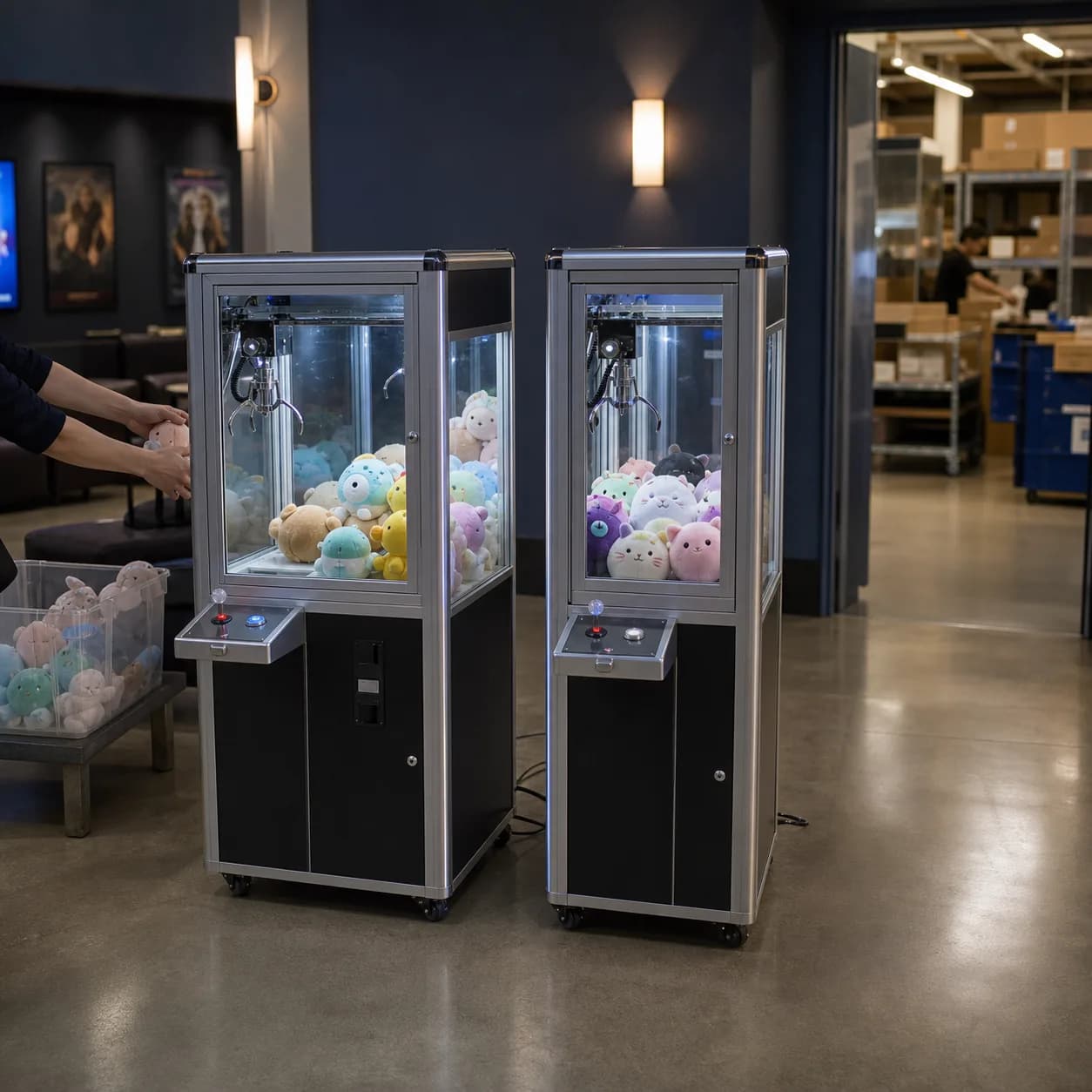
Yes. Mini claw machines are profitable when the location produces enough paid attempts and the operator controls the cost of prizes awarded. We usually see buyers focus first on foot traffic, but passing traffic alone doesn’t pay the bills. Guests must notice the prizes, understand the play quickly, and feel that another attempt is worthwhile. Compact cabinets can help because they fit revenue-producing equipment into small indoor spaces. Jisun models are suitable for malls, arcades, FECs, cinema lobbies, and supermarkets. Their metal and glass cabinets provide a clean commercial display look, helping small plush remain visible. The practical test is simple: calculate monthly play revenue, subtract every operating cost, then compare the result with the capital invested.
How much can a mini claw machine earn per month?
A mini claw machine’s monthly earnings equal the number of paid plays multiplied by the price per play. There is no honest universal revenue figure because traffic, play price, opening hours, seasonality, and guest conversion differ by site. When buyers ask us how much a mini claw machine can make per month, we recommend forecasting three cases: conservative, expected, and high traffic. Record actual paid plays rather than relying on general visitor counts. A cinema lobby may peak around screenings, while a supermarket may receive steadier traffic across the day. Revenue is only the first line of the calculation. Monthly profit appears after prize payouts, venue charges, payment costs, power, routine servicing, and machine recovery are deducted.
- Monthly play revenue: paid plays per day × price per play × operating days.
- Monthly operating cost: prizes awarded + venue cost or revenue share + payment fees + electricity + servicing.
- Mini claw machine profit per month: monthly play revenue − monthly operating cost − monthly machine-recovery allocation.
Use the same currency and tax treatment throughout the forecast. Small inconsistencies can make a marginal site look healthier than it really is.
What is the profit margin on a mini claw machine?
The mini claw machine profit margin is the percentage of revenue left after the costs included in your calculation. Gross profit margin usually subtracts direct operating costs, while net margin also accounts for overhead and machine recovery. A technical definition helps here: gross profit margin is gross profit divided by revenue, multiplied by 100. Operators should state which margin they mean before comparing locations. Prize cost is often the most adjustable direct expense, so track both prize cost per win and the number of plays between wins. A cabinet designed for 4#/10–15 cm dolls and small plush prizes gives buyers a defined merchandise envelope for planning cost, appearance, and replenishment.
| Metric | Formula | What it shows |
|---|---|---|
| Gross profit | Revenue − direct operating costs | Operating return before overhead and capital recovery |
| Gross profit margin | Gross profit ÷ revenue × 100 | Direct operating efficiency as a percentage |
| Net operating profit | Revenue − all allocated monthly costs | What the machine contributes after the selected costs |
| Break-even time | Total installed investment ÷ average monthly net cash contribution | Estimated time needed to recover the investment |
Which costs determine mini claw machine profit per month?
Prize consumption, site terms, payment charges, power, servicing, and capital recovery determine mini claw machine profit per month. Count landed equipment cost rather than cabinet price alone when calculating payback. Freight and local handling can change the installed investment, particularly when several cabinets are palletized or shipped together. Prize economics also need their own operating log: record stock loaded, prizes won, paid attempts, and remaining inventory. That gives you a real prize cost per play instead of a guess. Electricity belongs in the model, although it shouldn’t distract from the larger variables of play volume and prize payout. Jisun compact configurations are listed at either 120W or 150W, depending on the cabinet selected.
- Revenue inputs: paid attempts, price per attempt, operating days, and seasonal traffic.
- Direct costs: prizes awarded, payment charges, electricity, and routine service.
- Location costs: fixed rent, revenue share, or the allocation agreed with the venue.
- Investment costs: machine, customization, freight, handling, taxes, and installation where applicable.
One operator’s “profit” may exclude rent or freight while another includes both. Compare like with like.
How do cabinet size and specifications affect earning potential?
Cabinet dimensions affect where the machine can earn, not just how much floor space it occupies. One Jisun compact format measures 42 × 32 × 168 cm and is intended for high-traffic indoor venues. Another has a 56 × 44 × 168 cm footprint. These narrow floor plans can help operators test corridors, lobby edges, or unused retail areas without assuming that every site needs a large-format attraction. Stable placement still matters: the two cited configurations weigh 43 kg and 56 kg. Before ordering, match the proposed position with the cabinet footprint, prize size, electrical input, guest circulation, and restocking access. A claw machine is a commercial amusement cabinet in which a player pays for an attempt to control a claw and capture a prize.
| Planning field | Compact configuration | Alternative compact configuration |
|---|---|---|
| Cabinet footprint | 42 × 32 × 168 cm | 56 × 44 × 168 cm |
| Rated power | 120W | 150W |
| Voltage support | 110–240V/60Hz | 110–240V/60Hz |
| Machine weight | 43 kg | 56 kg |
| Prize planning | 4#/10–15 cm dolls and small plush prizes | 4# dolls and 10–15 cm prize items |
How should buyers forecast profit before ordering wholesale?
Build the forecast around a specific cabinet, specific location, and specific prize plan. Start with measured venue traffic, estimate the share that will play, and convert that into daily paid attempts. Then test lower traffic and higher prize consumption. This reveals whether the project still works when the first forecast is wrong. Buyers comparing multiple units should also consider how cabinet dimensions affect placement density and how standardized 10–15 cm prizes simplify purchasing and replenishment. For model selection and project planning, begin with our Mini Claw Machine Wholesale pillar page, review the commercial mini claw machine, and compare sourcing variables in our wholesale price and buyer guide.
- Choose the exact cabinet and reserve its measured floor area.
- Estimate paid plays for conservative, expected, and high-traffic cases.
- Apply your actual play price and venue agreement to each case.
- Calculate prize usage from the selected 4#/10–15 cm merchandise plan.
- Deduct all monthly costs and calculate the recovery period for the installed investment.
- Review actual play and prize data after launch, then adjust the operating plan.
What should a profit-focused wholesale request include?
A profit-focused request should connect the machine specification to the planned venue and business model. Tell us the destination market, number of units, available floor area, intended 10–15 cm prizes, and type of location. This lets our factory team discuss an appropriate compact configuration instead of treating every mini cabinet as interchangeable. Brand presentation can also form part of the project because we support custom logo and brand OEM/ODM work. Your internal forecast should keep customization and delivered investment separate from recurring operating costs; that produces a clearer payback calculation. We’ll use the operating brief to prepare the relevant factory quotation and specification details without inventing a public price that ignores configuration, quantity, and delivery requirements.
Planning a profitable mini claw machine rollout? Review how to choose a commercial supplier, then request a quote from Jisun with your venue, destination, quantity, prize plan, and branding brief.
Frequently Asked Questions
- How do I calculate mini claw machine profit per month?
- Multiply paid plays per day by the play price and operating days. Subtract prizes awarded, venue costs, payment charges, electricity, servicing, and the monthly allocation used to recover the installed investment.
- Can a smaller cabinet produce a strong return per square meter?
- Yes, when the compact footprint opens a productive position and paid-play volume supports the costs. Jisun configurations measuring 42 × 32 × 168 cm or 56 × 44 × 168 cm can be evaluated by profit per occupied floor area rather than revenue alone.
- Why does prize payout have such a large effect on margin?
- Every awarded prize creates a direct cost. Tracking paid attempts, wins, stock loaded, and remaining inventory shows the actual prize cost per play. Jisun compact cabinets are designed around 4#/10–15 cm dolls and small plush, giving operators a defined merchandise size for the calculation.
- Should electricity be included in a mini claw machine earnings forecast?
- Yes. Include it with the other monthly operating costs, using the applicable local tariff and operating schedule. The compact Jisun configurations discussed in the article have listed power ratings of 120W or 150W.
- Is monthly revenue the same as mini claw machine profit?
- No. Revenue is the money generated by paid attempts. Profit is what remains after the chosen operating expenses, location charges, and machine-recovery allocation have been deducted.
Related Buying Guides
Choosing a Commercial Mini Claw Machine Supplier
Learn how to evaluate a commercial mini claw machine supplier using practical cabinet, prize, power, branding, and purchasing criteria. Compare two compact Jisun formats built for commercial indoor venues.
Mini Claw Machine Wholesale Price & Buyer Guide
Mini claw machine pricing depends on the cabinet, quantity, customization, and shipping terms. This guide explains how to compare factory quotations without overlooking operating or freight costs.
Plush Claw Machine Wholesale Guide
A practical wholesale guide for buyers sourcing compact plush claw machines for malls, arcades, FECs, cinema lobbies, and supermarkets.