Best Locations for Claw Machines: Operator Guide
The strongest claw machine locations pair visible foot traffic with natural waiting time, suitable audiences, and practical installation conditions. This guide explains how buyers can compare venues, test exact positions, and match cabinets to each site.
AI assisted with the initial draft and structure. The published page is reviewed against Jisun source facts, product context and editorial requirements; the named reviewer is shown above when assigned.
The best locations for claw machines combine steady foot traffic, visible waiting time, an audience that welcomes small-prize entertainment, safe indoor placement, and enough room for players to stop without blocking circulation. Start with malls, arcades, FECs, cinema lobbies, and supermarkets, then validate each exact spot with a short operating test.
A claw machine is a self-service amusement cabinet in which a player controls a mechanical claw to try to retrieve a displayed prize. Location determines whether that cabinet becomes an impulse-play attraction or gets overlooked.
How do you find locations for claw machines?
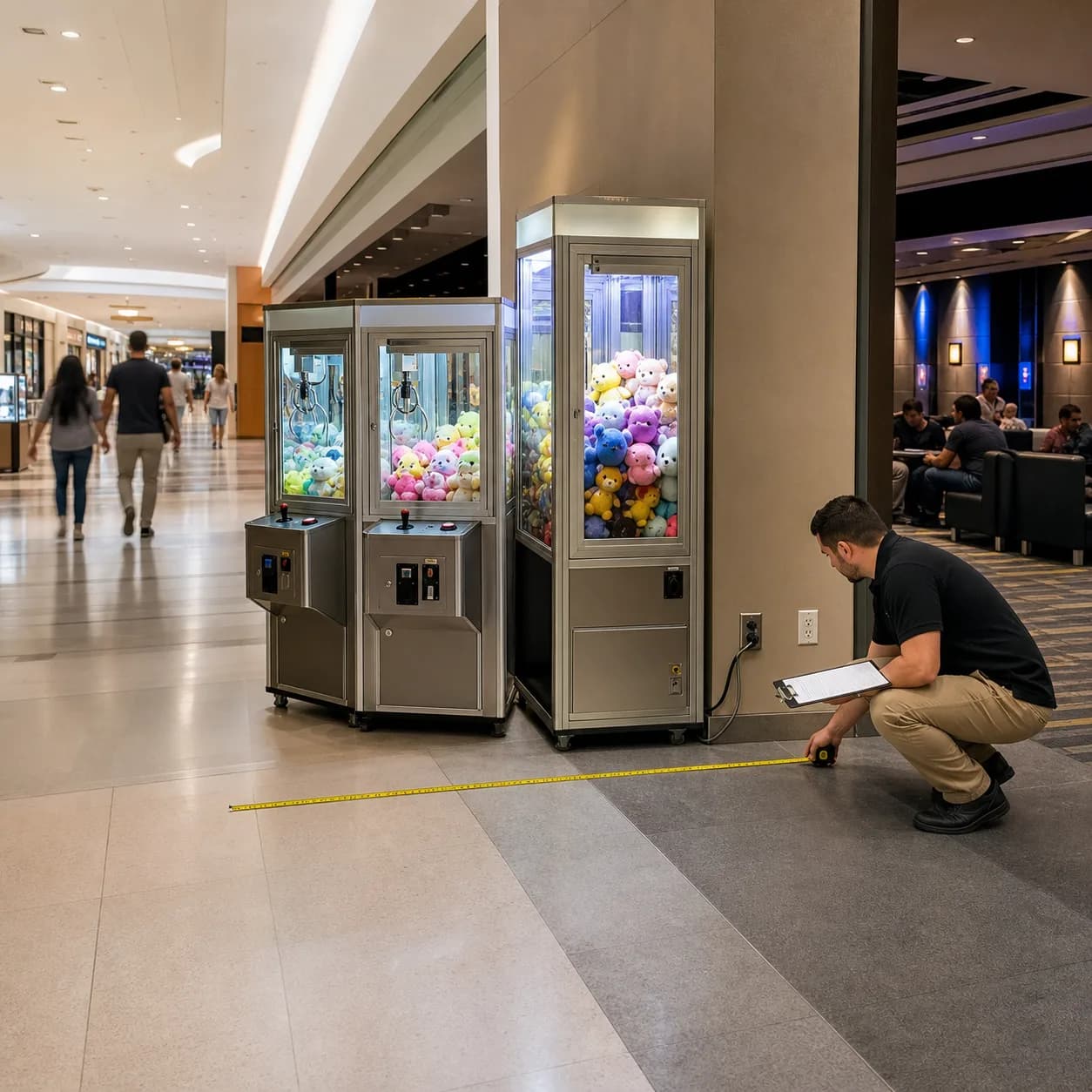
To find locations for claw machines, build a shortlist from places where people already pause, wait, browse, or accompany children. Visit each candidate during different trading periods and observe the exact path people follow—not just the venue’s total attendance. Then speak with the property manager about available floor space, electrical access, operating hours, access for delivery, and any rules covering noise, lighting, payments, or prize displays. In our factory discussions, we ask buyers to compare specific placement zones rather than broad venue categories. A busy shopping center can contain both an excellent cinema queue and a nearly invisible side corridor. Document the candidates in one scorecard so the final decision reflects observed behavior and installation reality.
- List venues whose customers have natural waiting or leisure time.
- Map entrances, queues, food areas, escalators, checkouts, and family routes.
- Confirm the usable floor area and delivery path with venue management.
- Record power availability, operating restrictions, and the commercial arrangement.
- Run a controlled placement test before committing to a larger rollout.
Which venue types are usually best for claw machines?
Malls, arcades, family entertainment centers, cinema lobbies, and supermarkets are the strongest starting categories because each can combine walk-by visibility with leisure or waiting time. Our machines are suitable for malls, arcades, FECs, cinema lobbies, and supermarkets, but the operating role changes by venue. An arcade cabinet joins an existing game mix, while a supermarket unit often serves shoppers near a family-oriented pause point. Cinema lobbies create concentrated periods before screenings. FECs support customers who already expect paid amusement. Mall placements can capture mixed-age traffic throughout the day. Buyers can review our broader capabilities as a claw machine manufacturer while planning a cabinet mix for more than one venue type.
| Venue type | Promising behavior to observe | Common placement risk |
|---|---|---|
| Shopping mall | Browsing, family movement, and leisure stops | A high-traffic path with no safe stopping area |
| Arcade or FEC | Customers already comparing games and prizes | Cabinet hidden behind taller equipment |
| Cinema lobby | Concentrated waiting before screenings | Traffic that disappears between showtimes |
| Supermarket | Family pauses near entrances or service zones | Interference with checkout or trolley circulation |
What makes one position inside a venue better than another?
The better position lets approaching customers see the prizes and understand the game before they pass it. Look for a clear sightline, comfortable stopping space, nearby power, and circulation that won’t be obstructed by a player or companion. Corners beside queues, transitions between entertainment and food areas, and open approaches can work when the cabinet remains visible from several steps away. Test the view at both adult and child height. Prize presentation matters, so buyers may compare a high-visibility format such as the Phone Booth Claw Machine with other cabinet styles. Here’s the operator’s reality: heavy footfall means little when every shopper is rushing past or watching for carts, stairs, and checkout lines.
How should the cabinet format match the available floor space?
Match the cabinet to the measured placement zone, ceiling clearance, access route, and player standing area before negotiating the final position. One Jisun upright format has an 86*80*220cm footprint for high-traffic locations, so buyers should plot the full width, depth, and height on the venue drawing rather than treating it as a generic machine slot. The selected position also needs room for normal play and service access. Electrical specifications belong on the same plan: this format has a 150W power rating with 220V/60Hz input. Don’t assume a nearby outlet makes the site ready. Confirm its voltage and frequency against the exact ordered configuration, then have the venue approve the connection and cable route.
| Planning field | Supplied specification | Location check |
|---|---|---|
| Cabinet size | 86 × 80 × 220 cm upright format | Plot floor area, height, player space, and service access |
| Rated power | 150W | Include the machine in the venue’s electrical plan |
| Input | 220V/60Hz | Verify compatibility for the exact destination site |
How can you test a claw machine location before expanding?
Test one defined position with a consistent cabinet setup, prize mix, price per play, and observation schedule. Record paid plays, repeat plays, quiet periods, customer approaches that don’t convert, and any obstruction or service issue. Keep the variables stable long enough to compare time blocks fairly. If you change the prize value, claw setup, payment method, and floor position together, you won’t know which change affected performance. A short-cycle format can help in busy settings: our 10-Second Challenge Claw Machine uses fast 10-second challenge gameplay that encourages repeat play. That benefit still depends on visibility, audience fit, and a position where customers can stop comfortably.
- Set a baseline configuration and document the exact floor position.
- Observe comparable time blocks across weekdays and busier periods.
- Separate first plays from repeat plays when the venue can track them.
- Note operational friction, including blocked views and difficult access.
- Move or scale the machine only after comparing the recorded results.
How do branding and payment choices affect location fit?
Branding and payment choices affect whether the cabinet belongs in the venue and whether its customers can start a game without confusion. A cinema promotion, family center, and supermarket campaign may require different cabinet artwork, colors, prize presentation, or transaction flow. We offer custom branding, cabinet artwork and payment interface options for OEM/ODM projects, allowing buyers to define those details around a specific deployment. Settle them before production. Payment hardware can change the front-panel layout and customer interaction, while artwork must suit the venue’s viewing distance and audience. When several sites are planned, document the approved configuration for each group so units intended for one operating environment aren’t mixed into another during delivery or installation.
Choosing a location and specifying the machine should happen together. Contact our factory team to share your venue type, floor measurements, destination electrical standard, preferred cabinet format, and project quantity, and request a tailored claw machine quote.
Frequently Asked Questions
- Which observations should go into a claw machine location scorecard?
- Record sightlines, natural waiting behavior, usable floor area, delivery access, electrical availability, operating restrictions, and whether players can stop without obstructing circulation. Compare exact positions rather than relying only on a venue’s total attendance.
- How can two candidate sites with similar foot traffic perform differently?
- Visitors at one site may be browsing or waiting, while those at the other are moving quickly toward checkouts, stairs, or exits. Prize visibility and safe stopping space can therefore matter more than the raw number of passersby.
- Why should buyers select a cabinet before finalizing the floor position?
- The venue must accommodate the cabinet’s actual width, depth, height, player area, service access, and electrical connection. For example, one Jisun upright format measures 86 × 80 × 220 cm and is rated at 150W with 220V/60Hz input.
- What should remain consistent during a location test?
- Keep the cabinet setup, prize mix, price per play, observation schedule, and floor position consistent. Changing several variables together makes it difficult to determine whether the location or the operating setup caused the result.
- Can a short game cycle help in a busy placement?
- Yes. Jisun’s fast 10-second challenge format encourages repeat play and can suit high-traffic environments, provided the cabinet remains visible and customers have enough room to stop and play.
Related Buying Guides
Claw Machine Wholesale: Factory Buyer’s Guide
Learn how to compare wholesale claw machines by venue fit, prize format, electrical specifications, cabinet construction, gameplay, and OEM/ODM scope.
Claw Machine Price from Manufacturer: Buyer Guide
Manufacturer pricing depends on the cabinet, order volume, electrical setup, customization, and shipping scope. This guide shows commercial buyers how to compare quotations on equal terms.
How to Choose a Claw Machine Manufacturer
A practical B2B guide for choosing a claw machine manufacturer based on factory capability, OEM/ODM support, cabinet specs, venue fit, and quote clarity.